Q: Can you introduce yourself and tell us what you’re currently doing?
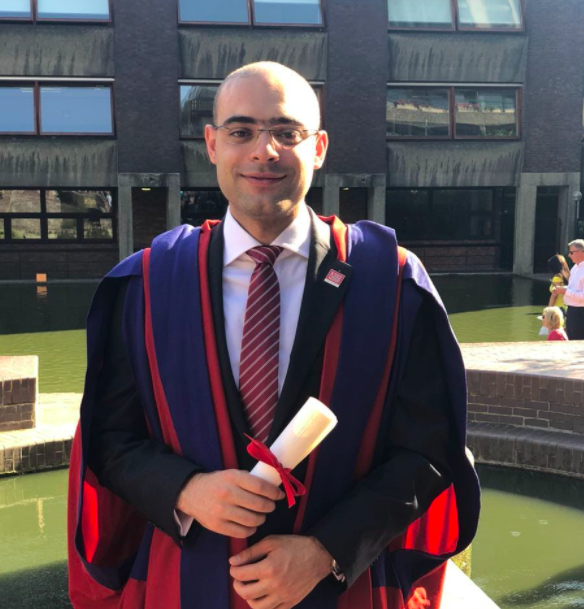
A: My name is Ahmed Alaa Fayed. I currently serve as a Member of the Egyptian Parliament on the House Foreign Affairs Committee, a role I assumed in January 2026. Alongside my political work, I’m also involved in academia, policy research, and the education sector as the CEO of a private K–12 educational group in Cairo.
Q: Tell us about your early life and upbringing.
A: I was born in Dokki, Giza, and grew up in a middle-class family in East Cairo alongside my three sisters. My father is an engineer and my mother is a dentist. Growing up in that environment instilled in me a strong appreciation for education, discipline, and public service.
Q: How did your education shape your career path?
A: I attended the Modern American School of Egypt before pursuing construction engineering at the American University in Cairo. Later, I shifted toward public policy, completing a Master of Public Administration at AUC, followed by a PhD in Public Policy from King’s College London. I also completed an executive certificate at Harvard Kennedy School. This combination of technical and policy education played a key role in shaping my interdisciplinary approach to governance and development.
Q: Were you involved in student activities during your school and university years?
A: Yes, very much so. I served as president of my school’s student council, and later became actively involved in student leadership at university. I was elected Student Union president at AUC during the 2011–2012 academic year, a particularly transformative period. I also contributed to reestablishing the Egyptian Student Union after the 2011 revolution and was elected as one of its vice presidents.
Q: What were some defining moments from your student leadership experience?
A: One key moment was leading a campus-wide strike in response to tuition increases, which ultimately resulted in capping those increases. More broadly, being involved in national student organizing during a historic political transition gave me early exposure to leadership, negotiation, and policymaking.
Q: How did your career evolve after university?
A: I initially pursued an academic path, teaching and conducting research in public policy. I held positions at institutions such as the Doha Institute and Nile University, and also worked as an adjunct professor at AUC. Alongside academia, I worked as a policy consultant, contributed to government think tanks, and engaged in leadership training programs at the National Training Academy.
Q: What led you to enter politics?
A: My involvement in public life started early through student leadership. Over time, my academic and policy work naturally evolved into political engagement. I joined the Egyptian Social Democratic Party in 2015 and gradually took on more responsibilities, including serving as a spokesperson during a presidential campaign.
Q: You ran for parliament before being elected. What did that experience teach you?
A: I first ran in 2020. Although I didn’t win, it was a valuable experience. It taught me the importance of grassroots engagement, resilience, and long-term vision. That campaign helped build the foundation for my successful run in 2026.
Q: What are your main priorities as a Member of Parliament?
A: My work focuses on foreign policy, climate action, and sustainable development. I’m particularly interested in how Egypt can position itself within global economic and environmental frameworks, while also ensuring inclusive growth domestically.
Q: How do you describe your political philosophy?
A: I would describe myself as a progressive, centrist social democrat. I believe in balancing economic efficiency with social justice—supporting private sector growth while ensuring strong social protections, access to quality education and healthcare, and environmental sustainability.
Q: Climate change seems to be a major focus for you. Why is that?
A: Climate change is one of the most pressing challenges of our time. It’s not just an environmental issue—it’s economic, social, and geopolitical. I’ve been particularly involved in advancing policies related to carbon markets, renewable energy, and aligning Egypt with global climate frameworks.
Q: What role does international cooperation play in your work?
A: A significant one. I actively engage with international institutions and participate in global policy dialogues. I believe Egypt should play a proactive role in shaping international cooperation, especially in areas like sustainable development and economic resilience.
Q: What advice would you give to current students and young alumni?
A: Stay curious, stay engaged, and don’t be afraid to take initiative early. Leadership doesn’t start with a title—it starts with action. Whether in school, university, or your community, every experience contributes to shaping your path.
Q: Looking back, how did your school experience influence who you are today?
A: My school years were foundational. They gave me my first leadership opportunities and helped shape my confidence and sense of responsibility. The values and skills I developed during that time continue to guide me today.
During his time at AUC, Fayed was clearly a leader in serving his peers and improving conditions for all AUC students, staff and professors. First, he worked, assisted and volunteered at a multitude of AUC functions- office of student development, the freshman advising office, the office of communication and marketing, core curriculum office and Alumni and trustee affairs office. Second, he made sure students’ interests were represented in the university’s various democratic processes. He was the undergraduate students’ representative at the university senate, readmission committee, bus transportation advisory committee and late drop committee. Third, as a master’s student he was involved in academic teaching, outreach, and was a research assistant in marginalized areas, cementing AUC’s commitment to its surrounding environment.
More significantly, during Fayed’s time across different student clubs and organizations, such as the Theatre and Film club, the AUC handball team, CIMAL, entrepreneurs society, ISLC, and representing construction engineering students at the Student Senate, he became well prepared for heading the Student Union. From 2011-2012, as student union president, he dedicated his time to public service to all those on campus, and outside. Recognizing AUC’s excellence in student mobilization, he exported the AUC model to collaboratively found a national Egyptian student union, which brings together student representatives from across the country. He was elected to represent the private universities, his efforts focused on bridging the gap between public and private, and creating the basis of a democratic national student body for all of Egypt.
His dedication to education and public policy did not stop there. He went on to complete his PhD in public policy from King’s College London (KCL), where he studied governance and corruption of the national Egyptian secondary school system beyond the limits of Cairo. He continued teaching at KCL, worked as a visiting scholar at both AUC and the university of Cambridge and published in international peer-reviewed journals. Currently, he is an assistant professor of public policy at the Doha institute for graduate studies; and is working on books on the wider issues of education policies across the Middle East.